12 Ekim 2012 Cuma

64th Annual Primetime Emmy Nominations- BC's Final Picks

To contact us Click HERE

Pandora Will Open Up Her Emmy Nomination Box Thursday Morning
Lots of TV Stars will have visions of Emmy Statuettes dancing in their head this summer.  (Photo by Bryan Curtiss)- Bryan Curtiss, Writer
On Thursday morning, Kerry Washington and Nick Offerman will announce the nominations for the 64th Annual Primetime Emmy Awards. One or both of them could be nominees this year. The Emmy Awards honor the best of television, but that is debatable. We each have our very own tastes in what we individually consider “The Best of Television” (please refer to The Bryan Awards as an example of this). But, year in, year out, there are more twists, shocks, and surprises than on Big Brother, and like with Big Brother, with the Emmy nominations, I have learned to “expect the unexpected.”

So, with that said, here are my final Emmy nomination predictions, starting with Comedy, then Drama, followed by Movie/Miniseries, and Variety/Reality.


Outstanding Comedy Series:
The Big Bang Theory (CBS)
Curb Your Enthusiasm (HBO)
Louie (F/X)
Modern Family (ABC)
Parks and Recreation (NBC)
30 Rock (NBC)

Upset Picks: Glee (Fox), New Girl (Fox), Veep (HBO)


Outstanding Lead Actor in a Comedy Series:
Johnny Galecki (The Big Bang Theory, CBS)
Jim Parsons (The Big Bang Theory, CBS)
Larry David (Curb Your Enthusiasm, HBO)
Don Cheadle (House of Lies, Showtime)
Louis C.K. (Louie, F/X)
Alec Baldwin (30 Rock, NBC)

Upset Picks: Adam Scott (Parks and Recreation, NBC), Jon Cryer (Two and a Half Men, CBS)


Outstanding Lead Actress in a Comedy Series:
Laura Linney (The Big C, Showtime)
Laura Dern (Enlightened, HBO)
Zooey Deschanel (New Girl, Fox)
Amy Poehler (Parks and Recreation, NBC)
Tina Fey (30 Rock, NBC)
Julia Louis-Dreyfus (Veep, HBO)

Upset Picks: Lena Dunham (Girls, HBO), Melissa McCarthy (Mike & Molly, CBS), Edie Falco (Nurse Jackie, Showtime), Lisa Kudrow (Web Therapy, Showtime)


Outstanding Supporting Actor in a Comedy Series:
Ty Burrell (Modern Family, ABC)
Jesse Tyler Ferguson (Modern Family, ABC)
Ed O’Neill (Modern Family, ABC)
Eric Stonestreet (Modern Family, ABC)
Max Greenfield (New Girl, Fox)
Nick Offerman (Parks and Recreation, NBC)

Upset Picks: Chris Colfer (Glee, Fox), Damon Wayans Jr. (Happy Endings, ABC), Bill Hader (Saturday Night Live, NBC)


Outstanding Supporting Actress in a Comedy Series:
Kathryn Joosten (Desperate Housewives, ABC)
Betty White (Hot in Cleveland, TV Land)
Julie Bowen (Modern Family, ABC)
Sofia Vergara (Modern Family, ABC)
Cloris Leachman (Raising Hope, Fox)
Kristen Wiig (Saturday Night Live, NBC)

Dark Horses: Jane Lynch (Glee, Fox), Casey Wilson (Happy Endings, ABC), Wendie Malick (Hot in Cleveland, TV Land), Jane Krakowski (30 Rock, NBC)


Outstanding Guest Actor in a Comedy Series:

Alan Alda (The Big C, Showtime)
Michael J. Fox (Curb Your Enthusiasm, HBO)
Matt Bomer (Glee, Fox)
Jimmy Fallon (Saturday Night Live, NBC)
Will Arnett (30 Rock, NBC)
Kelsey Grammer (30 Rock, NBC)

Upset Picks: Sean Hayes (Hot in Cleveland, TV Land or Parks and Recreation, NBC), Bobby Cannavale (Modern Family, ABC), Greg Kinnear (Modern Family, ABC), Louis C.K. (Parks and Recreation, NBC), Carl Reiner (Parks and Recreation, NBC)

Outstanding Guest Actress in a Comedy Series:
Whoopi Goldberg (Glee, Fox)
Ellen Barkin (Modern Family, ABC)
Patricia Clarkson (Parks and Recreation, NBC)
Melissa McCarthy (Saturday Night Live, NBC)
Elaine Stritch (30 Rock, NBC)
Kathy Bates (Two and a Half Men, CBS)

Upset Picks: Susan Sarandon (The Big C, Showtime), Dot-Marie Jones (Glee, Fox), Doris Roberts, Rhea Perlman, and/or Kristin Chenoweth (Hot in Cleveland, TV Land), Kathryn Hahn (Parks and Recreation, NBC), Zooey Deschanel (Saturday Night Live, NBC), Elizabeth Banks (30 Rock, NBC), Susan Sarandon (30 Rock, NBC), Blythe Danner (Up All Night, NBC), Megan Mullally (Parks and Recreation or Up All Night, NBC)

Outstanding Drama Series:
Boardwalk Empire (HBO)
Breaking Bad (AMC)
Downton Abbey – Masterpiece (PBS)
Game of Thrones (HBO)
Homeland (Showtime)
Mad Men (AMC)

Upset Picks: Dexter (Showtime), The Good Wife (CBS), House (Fox), Smash (NBC)


Outstanding Lead Actor in a Drama Series:
Steve Buscemi (Boardwalk Empire, HBO)
Kelsey Grammer (Boss, Starz)
Bryan Cranston (Breaking Bad, AMC)
Damian Lewis (Homeland, Showtime)
Dustin Hoffman (Luck, HBO)
Jon Hamm (Mad Men, AMC)

Upset Picks: Michael C. Hall (Dexter, Showtime), Hugh Laurie (House, Fox), Timothy Olyphant (Justified, F/X), Patrick J. Adams (Suits, USA)

Outstanding Lead Actress in a Drama Series:
Glenn Close (Damages, The 101)
Elizabeth McGovern (Downton Abbey, PBS)
Julianna Margulies (The Good Wife, CBS)
Claire Danes (Homeland, Showtime)
Mariska Hargitay (Law & Order: SVU, NBC)
Elisabeth Moss (Mad Men, AMC)

Upset Picks: Kyra Sedgwick (The Closer, TNT), Michelle Dockery (Downton Abbey, PBS), Jessica Paré (Mad Men, AMC), Kerry Washington (Scandal, ABC), Debra Messing (Smash, NBC)


Outstanding Supporting Actor in a Drama Series:
Giancarlo Esposito (Breaking Bad, AMC)
Aaron Paul (Breaking Bad, AMC)
Peter Dinklage (Game of Thrones, HBO)
Josh Charles (The Good Wife, CBS)
Mandy Patinkin (Homeland, Showtime)
John Slattery (Mad Men, AMC)

Upset Picks: Dylan Baker (Damages, The 101), Alan Cumming (The Good Wife, CBS), Walton Goggins (Justified, F/X), Neal McDonough (Justified, F/X), Jared Harris (Mad Men, AMC), Vincent Kartheiser (Mad Men, AMC), Andre Braugher (Men of a Certain Age, TNT)


Outstanding Supporting Actress in a Drama Series:
Kelly Macdonald (Boardwalk Empire, HBO)
Anna Gunn (Breaking Bad, AMC)
Dame Maggie Smith (Downton Abbey, PBS)
Christine Baranski (The Good Wife, CBS)
Archie Panjabi (The Good Wife, CBS)
Christina Hendricks (Mad Men, AMC)

Upset Picks: Morena Baccarin (Homeland, Showtime), January Jones (Mad Men, AMC), Megan Hilty (Smash, NBC), Anjelica Huston (Smash, NBC), Katharine McPhee (Smash, NBC)


Outstanding Guest Actor in a Drama Series:
Fred Willard (The Closer, TNT)
Chris Messina (Damages, The 101)
Michael J. Fox (The Good Wife, CBS)
Matthew Perry (The Good Wife, CBS)
Edward Asner (Hawaii Five-0, CBS)
Robert Morse (Mad Men, CBS)

Upset Picks: Paul McCrane (Harry’s Law, NBC), Alfred Molina (Harry’s Law, NBC), Mykelti Williamson (Justified, F/X), T.R. Knight (Law & Order: SVU, NBC)

Outstanding Guest Actress in a Drama Series:
Carrie Preston (The Good Wife, CBS)
Loretta Devine (Grey’s Anatomy, ABC)
Jean Smart (Harry’s Law, NBC)
Chloe Sevigny (Law & Order: SVU, NBC)
Joan Cusack (Shameless, Showtime)
Louise Fletcher (Shameless, Showtime)

Upset Picks: Debbie Allen (Grey’s Anatomy, ABC), Alexis Bledel (Mad Men, AMC), Julia Ormond (Mad Men, AMC), Bernadette Peters (Smash, NBC), Uma Thurman (Smash, NBC)


Outstanding Made for TV Movie or Miniseries:

American Horror Story (F/X)
Game Change (HBO)
Great Expectations – Masterpiece (PBS)
The Hatfields and McCoys (History)
Hemingway and Gellhorn (HBO)
Sherlock: Scandal in Belgravia (PBS)
Upset Picks: Five (Lifetime), Luther (BBC America), Page Eight – Masterpiece Contemporary (PBS), Treasure Island (SyFy)


Outstanding Lead Actor in a Made for TV Movie or Miniseries:
Woody Harrelson (Game Change, HBO)
Clive Owen (Hemingway and Gellhorn, HBO)
Idris Elba (Luther, BBC America)
Bill Nighy (Page Eight, PBS)
Benedict Cumberbatch (Sherlock: Scandal in Belgravia, PBS)

Upset Picks: Dylan McDermott (American Horror Story, F/X), Dominic West (Appropriate Adult or The Hour, BBC America)


Outstanding Lead Actress in a Made for TV Movie or Miniseries:
Connie Britton (American Horror Story, F/X)
Emily Watson (Appropriate Adult)
Julianne Moore (Game Change, HBO)
Nicole Kidman (Hemingway and Gellhorn, HBO)
Rachel Weisz (Page Eight, PBS)

Upset Picks: Patricia Clarkson (Five, Lifetime), Melissa Leo (The Space Between, USA)


Outstanding Supporting Actor in a Made for TV Movie or Miniseries:
Ed Harris (Game Change, HBO)
Powers Boothe (The Hatfields and McCoys, History)
David Strathairn (Hemingway and Gellhorn, HBO)
Ralph Fiennes (Page Eight, PBS)
Sir Michael Gambon (Page Eight, PBS)

Upset Picks: Denis O’Hare (American Horror Story, F/X), Jeffrey Tambor (Five, Lifetime), Peter MacNicol (Game Change, HBO), Tom Berenger (The Hatfields and McCoys, History), Tony Shalhoub (Five, Lifetime or Hemingway and Gellhorn, HBO), or Robert Duvall (Hemingway and Gellhorn, HBO)


Outstanding Supporting Actress in a Made for TV Movie or Miniseries:
Frances Conroy (American Horror Story, F/X)
Jessica Lange (American Horror Story, F/X)
Sarah Paulson (Game Change, HBO)
Mare Winningham (The Hatfields and McCoys, HBO)
Judy Davis (Page Eight, PBS)

Upset Picks: Gillian Anderson (Great Expectations, PBS or Moby Dick, Starz), Molly Parker (Hemingway and Gellhorn, HBO)


Variety Series:
The Colbert Report (Comedy Central)
The Daily Show with Jon Stewart (Comedy Central)
Jimmy Kimmel Live (ABC)
Late Night with Jimmy Fallon (NBC)
The Late Show with David Letterman (CBS)
Saturday Night Live (NBC)

Upset Picks: Conan (TBS), Kathy (Bravo), The Late Late Show with Craig Ferguson (CBS)


Reality-Competition Program:
The Amazing Race (CBS)
American Idol (Fox)
Project Runway (Lifetime)
So You Think You Can Dance (Fox)
Top Chef (Bravo)
The Voice (NBC)

Upset Picks: Dancing With the Stars (ABC), Survivor (CBS), The X Factor (Fox)


Reality Host:
Phil Keoghan (The Amazing Race, CBS)
Ryan Seacrest (American Idol, Fox)
Tom Bergeron (Dancing With the Stars, ABC)
Cat Deeley (So You Think You Can Dance, Fox)
Jeff Probst (Survivor, CBS)

Upset Picks: Heidi Klum (Project Runway, Lifetime), Padma Lakshmi (Top Chef, Bravo), Carson Daly (The Voice, NBC)


Other Things To Watch Out For:
- South Park being snubbed for Animated Program ("Jackin' It"- if submitted for Music and Lyrics, could sneak in that category)
- Can any other freshman series besides Homeland break in?
- What program will get 20 nominations or more?
- Are The Daily Show, The Amazing Race, Modern Family, and Mad Men beatable?
- What surprise snubs could happen?

The DJBC Happy Hour radio program will recap Thursday's nominations on Monday (July 23).


Queen of the Mist

To contact us Click HERE


Mary Testa and the ensemble in Queen of the Mist
Queen of the Mist is a new musical by Michael John LaChiusa (Marie Christine, The Wild Party), whichthe Transport Group produced at the Judson Gym in the West Village lastmonth.  Starring the fiercely charismaticMary Testa, the musical tells the story of Anna “Annie” Edson Taylor  (1838 – 1921), the first person to go over Niagara Falls ina barrel and survive—and on her 63rd birthday (in 1901), at that.
The musicalis significant for placing a middle-aged woman squarely at the center of itsnarrative.  In fact, only one otherperformer has a stable character part—Andrew Samonsky as Annie’s drunken,rough-hewn, opportunistic manager, Frank Russell.  The rest of the cast is a quintet of terrificactor/singers who cycle through a number of subsidiary roles, all written tosupport the journey of the central character.
Testa morethan meets the challenges of a role that requires her to be a stalwart,pragmatic single woman in an age when women were much more often domesticatedin heterosexual nuclear families.  Annieis a dreamer, a woman who insists, in one of the show’s best songs, “I havegreatness in me.”  How often do we see musicalsabout older, single women determined to actualize their dreams?
The show’sstructure, as well as its story, makes it unique.  This is not a typical “opposites attract,”heterosexual love story that resolves the relationships and the musical world’smetaphorical social divisions by the performance’s end.  Instead, Queenof the Mist keeps Annie alone throughout, and her relationship with Russellone of affection and grudging love, but not romance.  This makes Annie a remarkably originalcharacter even by present-day standards, let alone for an actual historicalwoman who came of age in the 19th century.
Before heridea to ride over the falls coalesces, Annie tries and fails to make economic endsmeet through various schemes.  Queen of the Mist’s book cleverly introducesus to her through long monologues of cunning and manipulation meant to distracther landlords and buy her time to pay her rent. In one scene after another, she’s evicted from her lodgings.
Annie tellsstories about once having been married, though she never was.  She lies about her age, moving herself nicely(over the course of a scene or a song or two) from 47, through her 50s, to 63,her actual age when she did what she called her “deed.”
Her sister, Jane, who lived with her husband and children in Auburn, NewYork, provides Annie’s gender foil.  Ensemble-memberTheresa McCarthy is wonderful as the pinched, submissive woman, who was happyto be a mother and wife, with no ambitions but to make her home.  Annie wanted much more than that.  Her outsized expectations chafed at herbrother-in-law, who insisted Annie leave his house on the one occasion Janerescued her sister from indigence.
Annie’s single-mindedpassion to distinguish herself and to make “the green” (as she calls money)keeps her from intimacy with her family or her few friends.  She carefully planned out her ride down thefalls, ordering a specially constructed, scientifically designed barrel andattending to the details of the stunt’s public relations as much as to therudimentary technology that she hoped would save her life.

Annie Edson and her specially designed barrel
Anniepersuades Russell to be her manager so that he can carry out her plan for howher stunt will appear to the public. Russell is an alcoholic accustomed to exploiting his clients, but he’sfascinated by Annie’s work ethic.  Hissurprising affection for this unusual woman is quite moving in Samonsky's subtle rendition.  He can’t emulate her strict morality; in fact,he steals her barrel after her successful trip down the falls, and employs animpersonator to play Annie in a seedy burlesque about her deed.
The raw spaceof the Judson Gym was designed for Queenof the Mist to evoke the banks of the river that runs into the rushingwaters of Niagara Falls.  The divided audiencesat on risers facing each other across the narrow playing space, with twosmaller playing spaces at either end. The intimacy of the stage meant that Testa could easily project Annie’smajesty into the audience.
Testainhabited fully a role that seems to have been written for her.  Her carriage perfectly erect, her hands quietat her sides, she used her face and her eyes and her large eloquent voice tocommand the stage, communicating the power and determination of a woman who hadto live by her wits in an age when women had few opportunities for agency.
Queen of the Mist underlines how unseemly it was for women toseek public attention at the turn of the 20th century.  Nevertheless, Annie did go down in history asthe first person to survive the plunge down Niagara Falls.
But after sheaccomplishes her dream, Annie becomes strangely distanced from herself and heradoring but finally impatient public.  Queen of the Mist’s second act quietsher down a bit and the show loses some of its focus and verve.

A quieter Annie after her "deed" is done
It’s notquite clear whether Annie is supposed to be disappointed about the reception toher stunt and how quickly she passes from the public eye, or if something elsehas suddenly drawn the wind from her considerable sails.  She also begins to lose her eyesight.  LaChiusa seems uncertain whether this is meantto be metaphorical or simply factual.
Finally,then, despite its considerable charms, Queenof the Mist seems a bit unsure what it’s about.  Is it a FloydCollins-style indictment of the press and the way that it did or didn’t makeheroes of people?   The press badgersAnnie for years to share the specifics of what she felt in that barrel as shemoved down the river toward the falls. But Annie believes the fact that she did the deed should have beenenough.  In the show’s 11th hourrevelation scene, after much prompting and suspense, Annie finally confesseswhat she felt during her ride down the falls.  She bares her heart as she describes herterror and her love for all those she feared she might never see again.
But Queen of the Mist doesn’t explain whyshe was reluctant to share these details all along, and what her hesitancymeans for the story’s larger implications. Does the show mean to suggest that Annie should have been moreemotionally available in her life?  Thata kind of emotional hubris was her downfall?
Or does theshow respect Annie for refusing to pander to sensationalism by describing heremotions and the terrifying sensation of plummeting over the falls, in thedark, with pounding water pummeling the thin wooden membrane between your bodyand your death?
Hard tosay.  In a talk-back after theperformance we saw, Testa and director Jack Cummings III said that Annie wantedto “own” her story, and felt that the factof her deed was enough.  We weren’t quite sure, however, that the show itself madethat clear.
Nonetheless, Queen of the Mist has wonderfulpotential and a terrific cast who spoke eloquently about the project.  Here’s hoping Annie Edson Taylor gets anotherchance at fame.
The FeministSpectator
Queen of the Mist, Judson Gym, December 1, 2011.

Once, the musical

To contact us Click HERE


The stars and supporting cast on the pub-style stage
When youenter New York Theatre Workshop’s space on E. 4th St. to see Once, the musical adaptation of the 2007Irish indiefilm (see my 2007 blog post on the film), the well-worn theatre suddenly feels like a party hall.  The stage has been transformed into a bar,replete with distressed old mirrors and sconce lights, and a low counter thatserves double-duty as a place for spectators to get a pint before the playproper starts and as a secondary acting platform for the considerable talentsof this musically distinguished and emotionally empathetic cast.
In Irishplaywright Enda Walsh’s faithful adaptation, the Dublincommunity onwhich the story focuses is bound by its music making.  The cast is small by musical theatrestandards, since the "community here," usually represented by dozens ofsupernumeraries, is the close-knit one of Dublin street buskers and musicianswho remain soulfully devoted to music as an expression of their pining spirits.
Steve Kazee plays “the guy,” a recentlyjilted, emotionally and artistically ambivalent singer/song-writer who at the show’sbeginning, after a wrenching solo, has decided to abandon his battered guitar on the street as a kind of remnant of his own lost soul.
But “the girl”(like “the guy,” also nameless, an odd conceit borrowed from the film)overhears his ballad and brings him emphatically back to his music and to hislife.  Played by the lovely, energetic CristinMilioti (last seen at NYTW in Ivo Van Hove’s Little Foxes), she drags him to a music store where she borrows apiano on which to accompany him in her resonant, equally soulful style.  Through sheer will and a bit of artfully withheldromance, she encourages him to resume his music-making in America, where he canreconnect with his departed girlfriend and have a wonderful life.
As in thefilm, music expresses the duo's personalities and their yearnings.  The musical's loveliest and most hauntingnumber remains the Academy Award-winning “Falling Slowly,” written andperformed by Glen Hansard and Markéta Irglová, the original guy and girl whoremain credited for the music and lyrics of this adaptation.  The ballad grows as a duet between the two,whose voices blend perfectly as their separate instruments play a kind ofsyncopated, already sad flirtation.

 Glen Hansard and Marketa Irglova, the original "guy" and "girl"
Although the pairfall in love as soon as they begin harmonizing together, the musical keeps themapart rather than uniting this typically central heterosexual couple as moreconventional musical stories are wont to do. In fact, one of the pleasures of Onceis watching it resist the stereotypical formula.  The community that typically mirrors thecentral couple's initial opposition—like the cowboys and the farmers who shouldbe friends in Oklahoma—here arealready united.
Walshmanufactures some humorous initial conflict between Billy (Paul Whitty), themusic store owner, and the bank manager (Andy Taylor) to whom the girl and guyturn for a loan to make their album. When the banker turns out to be a closeted musician (and anot-so-closeted gay man), he gives the couple the money and joins the band,overcoming Billy’s suspicion of capitalists to become part of the singing andplaying ensemble.
In fact, thatband of sympathetic brothers and sisters is one of the sweetest things aboutthis very sweet show.  Director JohnTiffany (Black Watch) keeps hisinstrument-playing and singing cast on stage throughout Once, John Doyle-style.  Heguides them toward saloon-style chairs that line the wide proscenium stage inbetween numbers.  From there, they watchthe action intently and provide the occasional musical punctuation orundertone.
The severalacoustic guitars, an electric bass, a banjo, an accordion, a ukulele, a bass,and two violins, as well as a drum set employed in the climactic studiorecording scene, compose the orchestra, all played by members of the cast.  The mournful ballads underscore the fatedlove story, and the musicians provide pre-show and intermission Irish pub musicto persuade the audience into the Dublin world of Once.
And theaudience loves it.  They approach the baron stage willingly before the show and during the intermission, where cast andcrew pull pints of Guinness and other beers. Several spectators the night I attended danced with the musicians who sangtogether center stage, stomping their feet Riverdance-style and making thatparticularly Irish sort of merry before the central story got underway.
The pre-showparty is a fun theatrical choice, shaking up, as it does, the conventionalseparation between performer and spectator. The choice to create a pub-style environment that lets the show be smalland intimate, signals from the start that Onceis not aspiring to more typical musical spectacle that would mock the more personal commitments at the film’s heart.

 The poster for the original film
The guy liveswith his father (David Patrick Kelly), a crusty old Dubliner named “Da,” abovethe vacuum repair shop they run together. When the girl finds the guy losing heart on the street, she asks him tofix her Hoover, insisting that he make the machine “suck.”  Because she’s Czech—and Walsh gets a fairamount of mileage from her Eastern European seriousness—she soberly sets aboutthe task of re-inspiring the guy toward his own talents.
He’s grudgingat first, floundering on the shoals of lost love and confusion about his ownambitions.  But she’s insistent.  In the first act, in fact, she’s a bit toosingle-minded in her intention to repair his heart, and appears the stereotypicalgirl in the service of a guy’s future rather than her own.
But Walshgives the character more nuances in the second act.  She has a child and a husband who’s on hisway back to Dublin from a trial separation. And although she’s drawn to the guy, she has a stalwart ethic thatrequires her to try to make her marriage work. That the guy and the girl clearly love one another but don’t becomelovers is a refreshing tactic for a musical. Their attraction shimmers around the show, and their sad but somehowright failure to consummate their love makes Once wistful and somehow true about those complicated affairs ofthe heart.
Bob Crowley’sevocative set and costumes are lit beautifully by Natasha Katz, who gilds theactors with the kind of romantic, introspective warmth that seems to deepen theiremotional complexity.  Many of the show’sscenes take place in squares of light that mark off the space, carving it intointimate encounters between pairs of characters--the guy and his father; theguy and the girl; Billy and his date.  Once, as a result, is an intimate,surprisingly quiet affair, in which between the numbers, the characters spendtime simply talking to one another about their desires, hopes, and dreams.
The Czechbackground of the girl and her extended family—her mother, daughter, andcousins figure heavily into her Dublin life—is played for laughs.  The cousins, of all the musical’s characters,are cardboard stereotypes meant to elicit the national confusions and languagehumor that comes from immigrants navigating new worlds.
Walsh andTiffany handle the film’s international flair with supertitles which, in acreative twist, project the English dialogue into the characters’ nativetongues.  That is, the audience sees thegirl’s exchanges with her family projected in Czech, and some of the Dubliner’sdialogue projected in Irish.  The actorsspeak in English with various degrees of Eastern European and Irish accents, noneof which are pronounced enough to get in the way of comprehension.
The show’s choreographyis light and unobtrusive, but occasionally inspired, as when the girl and theguy, in separate images, seem to sculpt the air with their arms, providing circlesof warmth and intimacy into which one of the other performers walks.  For instance, the girl, downstage center,curves her arm out in front of her, and one of the other women moves into herembrace, leaning her back into the girl’s chest and circling her arm around herwaist so that the girl can lay her chin on the other woman’s shoulder.
In anotherlight but poignant dance moment, when the girl listens to the guy’s music on apair of large headphones, the two other young women in the cast (both of whomplay the violin) mirror her as she moves about the stage, their handsoutstretched into the air with the exhilaration of listening to sounds you love.
Once isa charming production, currently selling out at NYTW and poised to move to Broadwayin February.  The show’s investorspremiered the production at Diana Paulus’s American Repertory Theatre in Cambridgebefore the move to NYTW; they apparently have always planned on a Broadway run.
When the showmoves to the Bernard Jacobs Theatre, I only hope it finds a way to retain theintimacy of its appeal for a larger audience. It would be a shame to sacrifice the pub-like atmosphere of the theatre,and the quiet simplicity of the acting and the singing, or to make the show whollybigger for a Broadway crowd.
The appeal ofOnce comes from the appropriate scale of its ambitions—to tell a story through lovely ballads,sung from broken, yearning young hearts.
The FeministSpectator
Once,New York Theatre Workshop, December 16, 2011.

Codependent Lesbian Space Alien Seeks Same

To contact us Click HERE

Film poster; Suzan Ziegler and Lisa Haas
I had the pleasure of seeing Codependent Lesbian Space Alien Seeks Same at the Galway Film Festival in Ireland last summer.  It's now playing through January 12 at ReRunGastropub Theatre in DUMBO (more info below).
The film, written and directed by Madeleine Olnek, is a lovely, quirky, comic fantasia, with a beautifully understated performance by Lisa Haas as the sweetly codependent lesbian who's fallen in love with a space alien.  Filmed in a sort of Ed Wood, low-budget camp sci-fi style, Codependent offers a fun queer evening at the movies.
Olnek was a regular at the WOW Café in the 1980s, when the underground lesbianperformance space was breaking rules about theatre and poaching from popularculture to rewrite what we understood of gender and sexuality norms.  The film is based on her play of the same title, which will soon be published in acollection of work from WOW that Holly Hughes and Alina Troyano (CarmelitaTropicana) are co-editing for the University of Michigan Press.  Olnek made the play into an indie feature film that’s now making the rounds on the festivalcircuit.  I caught the showing on thefirst night of the Galway Film Festival at Town Hall last July.
In true WOW style, thefilm both quotes and breaks the genre conventions on which it’s based.  Jane (Haas) is a desperately shy, lonelylesbian clerk at a greeting card store, who finds a note dropped seemingly outof the blue in which a lesbian space alien asks if they can be friends.  As Jane’s therapist (the wry Rae C. Wright)tries to help Jane puzzle through her emotions while persuading her that shehasn’t really been contacted byaliens, the planet Zots suffers an environmentalcrisis.  They believe their ozone layeris being destroyed by “big feelings,” and resolve to send to Earth any of theircitizens whose love affairs are damaging their planet.  On Earth, the reasoning goes, the aliens’hearts will be broken, and they’ll return to Zots cured of their commitment tolove.
And so begins a tale ofaliens-on-another-planet, in which the sexual and cultural mores of Earth clashwith the otherworldly style of the citizens of Zots.  Beaming down into Jane’s world, Zoinx (thehandsome, square-jawed Susan Ziegler) targets the shy lesbian for herexperiment in Earth-bound relationships. Despite her monotone, high-tech, echoing voice and her utter lack ofhuman affect, Jane finds Zoinx charming.
Part of the film’s joke is that Jane never acknowledges Zoinx’sstrangeness, accepting the alien’s bald head, her never-removed large,Elizabethan-style collar, which nearly encircles her starkly prominent pate,and her strange way of expressing affection (she puts her hand against Jane’snose in an awkward gesture whenever she’s feeling intimate).  Jane is so delighted by Zoinx’s company thatshe happily engages her alien customs and generously teaches Zoinx the equallystrange ways of Earth.
Two other aliens havebeen sent to Earth to participate in Zots’ project.  Bar (Cynthia Kaplan) and Zylar (JackieMonahan) have the misfortune of having “big feelings” for one another, but tryto find earthlings who might cure them of their mutual affliction.
Olnek includes hilarious scenes in whichvarious local lesbians respond to Zylar’s personal ad (written and videoed),and find themselves incapable of understanding or accepting what looks to themlike weird role-playing.  In theirone-note delivery, Bar and Zylar’s declarations of desperate love both undercutand underline the typical (or is it stereotypical?) excess of lesbianattachments with truly funny, sweet knowingness.
Two “men in black,”federal agents of some sort who track the aliens’ activity on Earth, shadowJane and Zoinx, trying to figure out the place from which the aliens enter andleave the country.  Their scenes arefilmed almost entirely in a parked suburban van, where the senior agent (DennisDavis) complains that he’s always passed up for promotion, watching those he’strained leapfrog over him professionally. His junior partner (Alex Karpovsky) asks him probing questions,inquiring, for instance, whether his wife, Debbie, is a “transman,” to the guy’sutter perplexity.
The two men’s deadpanhumor offers a terrific counterbalance to Jane and the aliens’shenanigans.  Their surveillanceactivities also allow Olnek to feed them anthropological lines about lesbianrelationships, as their ridiculous comments about whether these romances last (for one example) provide both a dominant cultural voice and an eye that lets them peer into themargins with a rather friendly, liberal curiosity.
Davis and Karpovsky play their scenes with alovely improvisational tone and Davis, in particular, comments as much onconventional masculinity as Jane and the aliens comment on lesbianrelationships.
Codependent Lesbian Space Alien is filmed with an intentionallylow-budget gestalt reminiscent of Ed Woods’ opus and the science fictionmovies of the 1950s.  Olnek uses low-techspecial effects to represent the aliens’ space ship, and the film’s black andwhite stock lets her use fun ‘50s-style titles and images of galaxies swirlingin space.
The music, too, quotes ‘50s melodramaticfilm conventions to over-emphasize emotions and to help announce Olnek’saffectionate parodies not only of sci-fi but of stereotypes of contemporarylesbian relationships.
Watching actorsdressed as aliens walking robotically through real New York East and WestVillage locations while no one on the streets blinks an eye is also a hoot.  Codependentsends up being a sweet, funny love story in which two deeply “different” womentriumph over their odds.
At a public discussion after theshowing in Galway, Olnek described how she researched the genre and understandsits roots in Cold War paranoia.  Aliens,she pointed out, where often portrayed as they are in her film (that is, bald and homogeneous in appearance) torepresent Americans’ fear of the uniformity a Soviet take-over might impose.  Likewise, Olnek suggested, their monotonespeaking voices borrow from those ‘50s sci-fi movies, in which the aliens’voices, too, were leeched of individual character and affect.
Putting thesecharacteristics in a lesbian context, however, makes them sweet andhilarious.  Jane takes Zoinx out for adrink at the Cubbyhole, a lesbian bar in Greenwich Village, where Jane whispersthat the clientele tends to be unfriendly. When Zoinx asks Jane to dance, she happily complies, trying to turn herembarrassment into a kind of pride when Zoinx's moves prove anything butconventional.  The reaction shots arehysterical.
Go; you'll have fun.
The Feminist Spectator
Codependent Lesbian Space Alien Seeks Same, through January 12, ReRunGastropub, DUMBO, Brooklyn.

George Jean Nathan Award for Dramatic Criticism, 2010-2011

To contact us Click HERE

Just a note to say that The Feminist Spectatorblog won the George Jean Nathan Award for Dramatic Criticism for2010-2011.  I’m delighted by thishonor.  The Feminist Spectator is thefirst blog ever to receive the award in its 56 year history, and I’m only theseventh woman to win in the history of the award.  The last woman so honored was my friend andcolleague Alisa Solomon, who won for her book Re-dressing the Canon:  Essays onGender and Theatre in 1998.  Iattended Alisa’s celebration party at PS122 that year, and remember the pride Ifelt in her accomplishment.  I’m thrilledto be joining her and so many other critics and writers I admire in thisdistinguished company.
Other recent award winners include CharlesMcNulty (chief theatre critic at the LATimes), Marc Robinson (for his book TheAmerican Play), Randy Gener (for his writing at American Theatre), H. Scott McMillin (for his book The Musical as Drama), and Ray Knapp(for his book The American Musical andthe Formation of National Identity). The prize is adjudicated by the chairs of the English Departments atCornell, Yale, and Princeton, though Cornell administers the award.
Karen Fricker wrote a lovely post in her theatre blog at The Guardian about thesignificance of my award, noting that Nathan award's history of gender imbalance “mightreflect the field’s demographics, [but] it does nonetheless prompt questioningabout why criticism is still largely perceived and practiced as a man’s game,when the accomplishments of Dolan and other leaders in the field . . . provethat turning out incisive, engaging critical prose about what happens on astage does not require a Y chromosome.”  
The significance of the Nathan award going to ablog has also been remarked by various commentators.  London-based theatre critic Mark Shenton, onhis blog Shenton’s View, suggests that “the web can also usefully provide aforum for critics to do their work away from the commercial and spacerestraints that typically operate in newspapers.”  Shenton discusses the recent firing oflong-time Village Voice film criticJ. Hoberman as an example of the sad state of contemporary arts criticism, and saysthat Hoberman has responded to his ouster by announcing that he’ll start ablog.  Shenton also notes that HowardKissel, who once wrote for the New YorkDaily News, now regularly contributes his criticism to the onlineHuffington Post.
Clearly, there’s a lot to say about the state oftheatre and arts criticism.  I’m hopingto sponsor a panel discussion about gender and criticism, and about blogging asa forum for criticism, as part of my Nathan award celebration.  Save Saturday,April 28, tentatively planned as the date for an event herein Princeton.  Details forthcoming.
Meanwhile, I want to take the opportunity of theaward to thank those of you who read this blog. When I first started writing The Feminist Spectator (seven years agothis August), I felt like I was sending words out in the void, happy to seethem move off my private screen but unsure where and with whom they mightland.  Learning that so many of you readthe blog, and engaging your comments and quarrels, gives me great pleasure, andencourages me about people’s desire to engage long-form, generative arts criticism.
I’m so grateful for the critical community yourreading creates for my writing.
The Feminist Spectator

11 Ekim 2012 Perşembe

Girl with the Dragon Tattoo

To contact us Click HERE

Rooney Mara as Lisbeth Salander
David Fincher’s tense, moody film adaptation ofthe popular Stieg Larsson book actually improves on the readingexperience.  Where the book offered agreat story with plodding prose, Fincher’s film cuts the narrative to the bonewhile staying faithful to Larsson’s plot and characters.  The film’s visual style makes it a pleasureto watch, evoking both the cosmopolitanism and gritty urbanism of Stockholm andthe frozen, snow-blown north Sweden countryside where much of the centralmystery unravels.
For a film that’s in large part about an ace computerhacker, Fincher both downplays and makes visually interesting LisbethSalander’s notorious skills, intercutting shots of her snub-nailed fingersflying over her keyboard with those of her intense gray eyes, replete witheyebrow-piercings, peering intensely at the screen.  Only sparingly does Fincher use screen shotsthat indicate she’s reading other people’s email.
The film is a huge improvement over the Swedish versionreleased a few years ago and starring Noomi Rapace as Lisbeth, which I found amore literal, bloodless adaptation. Fincher’s slick Hollywood idioms turn the story into a stylish,fast-paced thriller.  In the openingcredits (as other critics have noted), the director nods both musically andvisually to the iconic James Bond films, a nice intertextual reference, sinceFincher’s Mikael Blomkvist is played by Daniel Craig, the latest Bond.
Fincher also judiciously uses atmospheric, nearlyTechnicolor flashbacks to the Vanger family’s 1960s history, when the familypatriarch’s treasured niece, Harriet, mysteriously disappeared.  Fincher makes the American adaptation ofLarsson’s story more vivid, lending cinematic appeal to the narrative while he movesit smoothly through its paces.
Thereal revelation in Fincher’s Girl withthe Dragon Tattoo is Rooney Mara as Lisbeth Salander.  Nominated for a Golden Globe (which she lostto Meryl Streep for The Iron Lady)and now for a Best Actress Academy Award, Mara deserves the accolades heaped onher performance.  Her Lisbeth is slightbut fierce; Mara seems both smaller and steelier than Rapace was in the role,more emotionally fragile but more physically and psychically determined.
Inher early scenes in her kindly employer Dragan Armansky’s office (Goran Kisnjic,in a small but empathetic supporting role) and in her first meeting with NilsBjurman (Vorick van Wageningen),  herevil new guardian, Lisbeth refuses to make eye contact.
Butwhen she does shift her gaze to look directly and defiantly at herinterlocutors, you see a young woman who’s absolutely in control of her traumaticpast (about which we learn very little in this first film of the trilogy).  She’s taught herself a kind of discipline thatkeeps her highly functioning while letting her passion for vengeance simmerjust underneath the surface of her skin. Those gray eyes become the swing door to a boiler room of the soul,where her rage is stoked by knowing that the social corruptions—most of themgendered—that have kept her a ward of the state since she was twelve continueto structure Swedish life.
Onthe other hand, if you don’t know her backstory, Lisbeth doesn’t necessarily seemmotivated by revenge.  My intrepidfilm-going companion, Feminist Spectator 2, hasn’t read any of the Larsson books,and found Lisbeth even more fierce and fascinating because she appearsbrilliant, scary, and tough without being psychologized.
Dragon Tattoo is, of course, just thefirst in what will be a new trilogy of films based on Larsson’s story.  In this one, all we hear of Lisbeth’s past iswhat she mutters to Blomkvist when he’s finally gained her trust.  When he asks her why she’s still a ward ofthe state, Lisbeth admits matter-of-factly that she’s considered criminallyinsane because she set her father on fire and burned 80 percent of hisbody.  But since even this tiny, teasingrevelation comes relatively late in the film, FS2 says spectators have alreadycome to admire her without needing this justification.
Lisbeth’ssordid history will be fully explicated in the next two films.  Mara, however, plays her with full knowledgeof the character’s past and her journey into her vexed present.  Mara’s achievement is to make Salander afierce, even feminist, character without creating her as a monster.  Sure, all her Goth accoutrements are in place,from her jet-black Mohawk to her kohl-lined eyes to her multiple facial andbody piercings, along with her leather jacket, knapsack, boots, and greencanvas cargo pants.
Lisbethsmokes like a tough, holding her cigarettes between her thumb and herforefinger and squinting at the ubiquitous smoke.  She wears ratty black t-shirts andsweatshirts with hoods she pulls up to hide beneath.  When Blomkvist barges in on Lisbeth and aone-night-stand she’s picked up at a lesbian bar, her tattered t-shirt reads“Fuck Off You Fucking Fuck” in faded stenciling.  (But he’s undeterred.)  Her neck is adorned with heavy chains andrazor blades, the jewelry of a woman who refuses to submit.
Lisbeth, hooded
[If you haven’t read Larsson’s books or seenthe Swedish film trilogy or Fincher’s adaptation,spoilers follow.]
AlthoughLisbeth is a force to contend with, her new guardian decides he can use hispower over her for his own nefarious sexual purposes.  Bjurman forces her head into his lap at theirfirst meeting, threatening to commit her to an institution if she doesn’tcomply.  When she sees him again,required to ask him for money since he’s taken control of her affairs, he rapesher brutally, sadistically enjoying the pain and humiliation he inflicts.  But it doesn’t take long for Lisbeth to exacther revenge, forever reducing her rapist to a quaking eunuch.
Lisbeth threatens Bjurman in an elevator
ToFincher’s credit, the film doesn’t sensationalize Lisbeth.  The other characters don’t react to her asthough she’s a spectacle, undercutting what might be spectators’ expectationsthat she’ll create a stir simply by how she looks.  Instead, lawyer, Dirch Frode (StevenBerkoff), dispatched by the wealthy Henrik Vanger (Christopher Plummer), treatsLisbeth respectfully, aware of her talent as a researcher and overlooking heropen hostility.
Likewise,when Blomkvist peremptorily visits her apartment after he learns that she’shacked into his computer, he, too, is unfazed by her unkempt appearance andaggressive demeanor.   Instead, he insists that she drink the coffeeand eat the breakfast he fixes for her while he persuades her to help him findHarriet Vanger’s murderer.
AsFS2 points out, that the film’s “good” men react generously to Lisbeth directsspectators to see her magnanimously, too. On the other hand, FS2 continues, Mara is a beautiful young woman, andthe camera exploits her small, perfect features, her flawless skin, and herclear gray eyes.  That is, despite allher bravado and her frightening accessories, Fincher takes care to on somelevel glamorize Lisbeth, to keep her safe from the audience’s, as well as theother characters’, antipathy.
Eventhe police officers she approaches while she’s doing her work seem to findnothing remiss in Lisbeth’s outfit or her bearing.  They worry that the information she wantswill upset her or they’re annoyed because she expects unusual access anddemands too much time.  But they obviouslydon’t see her as a freak.
Nonetheless,she rides a mean motorcycle and wears a fearsome helmet.  Lisbeth’s heroism comes from her charactermore than it does from her actions.  Whenshe forces the villainous Martin Vanger (Stellan Skarsgard) off the bridge on hisfamily’s island, causing his car to overturn and catch fire as he stares out,doomed and helpless in the driver’s seat, Lisbeth watches without remorse.
Andwhat a nice switch to see her rescue Blomkvist from certain death instead ofvice versa.  Too often in suspense filmslike Dragon Tattoo, it’s thewoman—however intrepid and smart—who is saved at the end by the man when shefinds herself unwittingly trapped in the villain’s house.  In DragTattoo, on the contrary, at the film’s climactic moment it’s Craig/Bond/Blomkvistwho is trussed up like a bird waiting to be plucked, and it’s Lisbeth whoseeleventh hour appearance, wielding a nasty golf club, saves his life.
Lisbethand Blomkvist simultaneously solve the central mystery of who has beenmurdering women—all gruesomely raped and slaughtered with references to Bibleverses—around the time Harriet Vanger disappeared.  But it’s Lisbeth who tracks the killer to hislair after Blomkvist falls into his trap, and Lisbeth who, once the demon isdispatched, goes on to vindicate Blomkvist’s wrongful slander conviction in theWennerstrom corporate corruption case that sets Larsson’s plot in motion.
The Wennerstromrevenge subplot of Dragon Tattoo isnearly campy, as Lisbeth sheds her signature style for a Dolce and Gabbana lookthat one critic rightly called “drag.” She dons a blond wig and outsized sunglasses, a form-fitting dress andstiletto heels, to move some funds around various off-shore banks, creating atrail of financial malfeasance that bankrupts Wennerstrom, exonerates Blomkvist,and secures Lisbeth’s independent future.
Mara as Lisbeth in drag
Inher drag scenes, Mara beautifully performs Lisbeth’s disdain for her temporary performanceof conventional femininity.  When hermasquerade is over, she tosses her earrings down an airport sink and throws herwig out the window of a train.  Thesequence is a wonderful illustration of Lisbeth’s skill as an operative, but aneven better demonstration of her utter aversion for traditional femininecostumes and behavior.
I wasactually surprised that Fincher’s film leaves Lisbeth’s feminism so intact.  I found Fincher’s representations of women inhis film, The Social Network, misogynist.  Those who disagreed with me often pointed toMara’s character in that film; she plays Mark Zuckerberg’s smart and cutting butquickly dismissed and ultimately irrelevant girlfriend.
Butwhile women were incidental sexual playthings in The Social Network, Dragon Tattoo is very much Lisbeth’s film.  She’s its moral and narrative center and itskeen social observer.  Watch Mara’s earsand eyes perk up when Blomkvist invites her to help him find “a man who killswomen” (which was apparently the title Larsson preferred for his first book).
Lisbethis also the film’s most interesting character study, not because of how shelooks and dresses but because of how she reacts to the world around her andthen acts.  Mara has little dialogue, but her expressiveface and her physical commitment to Lisbeth make her fascinating.  Watch her exit from the elevator where sheexcoriates the reprehensible Bjurman and leaves him terrified as the doorsclose behind her.  Just turning her backon her guardian is a moment of utter command, clarity, and complexity.
Lisbeth/Maraalso brings Dragon Tattoo asurprising sense of humor.  When shebegins working with Blomkvist, the couple hunch over his laptop in the coldcabin Henrik Vanger has provided for him. She rolls her eyes as Blomkvist slowly pecks at the keys to bring upscreen images.  It’s a small buthilarious moment, as Mara gives Lisbeth an interior life lets her drolly,wordlessly comment on her male partner’s technological inadequacies withoutneeding to perform her superiority.
Lisbethis firmly in control of their relationship. She initiates their first sexual encounter; she demands that he stoptalking until she has her orgasm; she saves him from certain death; and shedelivers the goods on Blomkvist’s nemesis, Hans-Erik Wennerstrom (Ulf Friberg),which restores Blomkvist’s reputation.
My quibbleswith Fincher’s representation of Lisbeth are minor.  For example, after she’s raped by Bjurman,she stumbles home for the de rigueur victim-in-the-shower scene, where we seeher bruises and the blood running from her body into the tub.  (I guess it’s difficult to signify pain in afilm without these iconic signs. Although Mara does an excellent job screaming Lisbeth’s rage as shestruggles against Bjurman’s restraints.)   The next time we see her, Lisbeth is in alesbian bar, where she picks up the (beautiful) woman who Blomkvist findssharing her bed the next morning.
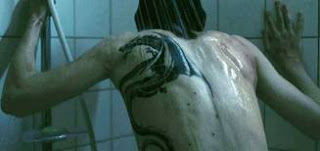
The dragon tattoo and Lisbeth in pain
Thejuxtaposition of the rape and the lesbian bar scene makes it seem as though malesexual violence has propelled Lisbeth toward sex with women.  Instead, in the book, she has an on-goingrelationship with a woman that mirrors Blomkvist’s relationship with hiscolleague, Erika Berger (Robin Wright), and clarifies that one of Lisbeth’scharms is her assertive bisexuality.
Likewise,Dragon Tattoo’s last several scenesfocus too much on Lisbeth’s unexpected affection for Mikael.  She tells her beloved former guardian, HolmerPalmgren (Bengt CW Carlsson), who’s in a nursing home recovering from a stroke,that she’s made a friend.  She buys Blomkvistan expensive leather jacket and she rides off to deliver it to him.
Despiteher strength of character and insight, Lisbeth is emotionally immature, andhasn’t picked up Blomkvist’s cues.  Soshe’s devastated when she arrives at the Millenniummagazine offices to find the flirtatious Mikael going off in a taxi with Erika.  The film ends on Lisbeth’s romanticdisappointment, which undercuts her earlier rejections of heterosexual femininity,especially for those spectators who haven’t read or seen the earlier version ofthe trilogy and don’t understand—as they say—where she’s coming from.
Butstill, Fincher and Mara make Lisbeth complicated enough.  That final moment could be read as a strongwoman realizing she was about to succumb to sentiment and abruptly choosing notto.  (Well, maybe that’s a stretch).  And Lisbeth does seem young.  In comparison, Fincher portrays Blomkvist as squarelymiddle-aged, and steers Craig far from his Bond action hero routine.  The actor sports an unshaven, grizzledsalt-and-pepper chin throughout the film, and rather than leaping tallbuildings and consulting cool gadgets, he’s often physically compromised.
Forexample, when he creeps around Martin’s glass-walled lair in the film’s climax,he’s the one who takes a kitchen knife from the counter, intending to defendhimself as ineffectually as a typical female victim in a horror film.  Blomkvist is the one who falls when he tries torun from Martin’s house and who is lured back in to the man’s trap.  As Martin boasts with a sneer, people’sdesire not to offend often trumps their instincts for self-preservation.  (Skarsgard plays the villain with the perfectmix of unctuous obsequiousness and arrogant pride.)
Blomkvistis the first man who’s demonstrated this self-defeating instinct to Martin.  Blomkvist is a metrosexual intellectual, anot quite effete representative of the fourth estate, and Craig plays him withintelligent bemusement and horror at the grisly murders his researchuncovers.  His black-rimmed glasses hangcrookedly off his ears instead of over his head, and he pulls them onto hisface to peer into documents and computer screens.  Using eyeglasses to signify intelligence is atired cliché, but Craig at least makes the gesture convincing.
Blomkvist (Craig) and Erika (Wright) at the magazine offices
Wrightplays Blomkvist’s long-time friend and sometime bed-mate Erika as hisintellectual and political companion.  Wright’sbeauty is only enhanced by the lines on her face.  The middle-aged couple has a lived-inrelationship, even though she remains married to her husband.  Blomkvist and Erika are comfortably establishedin their lives, in contrast to Lisbeth, who’s still struggling with the tangledtendrils of her past.
Lisbeth’srelationship with Blomkvist might be a turning point.  A scene in which they work together on thebed in a hotel room, with him in a white terry robe and her in her Goth outfit,is a nice moment of intimacy across clear differences.  But she’s still testing new contours for herlife, while his are indisputably firm.
It’sa shame, then, that the film’s ending makes Lisbeth seem a jilted lover, whenher character is otherwise so compelling, strong and competent.
Onelast note:  I’m surprised that criticsand spectators refer so often to what they consider the film’s extreme violenceand sexuality.  While the rape scene is certainlyhorrific, Dragon Tattoo didn’t strikeme as significantly more brutal than any other shoot-‘em up, set-‘em-on-fireaction flick.
Doesthis film seem more extreme because its hero is a woman?  Because Lisbeth neutralizes Bjurman with a stungun and then tattoos “I am a rapist pig” across his naked stomach?  Because it’s Martin, the male killer of women,who dies in a ball of fire?  Or becauseit’s Daniel Craig who’s victimized and saved by a woman in the end?  Just wondering.
TheFeminist Spectator